 Grenvi
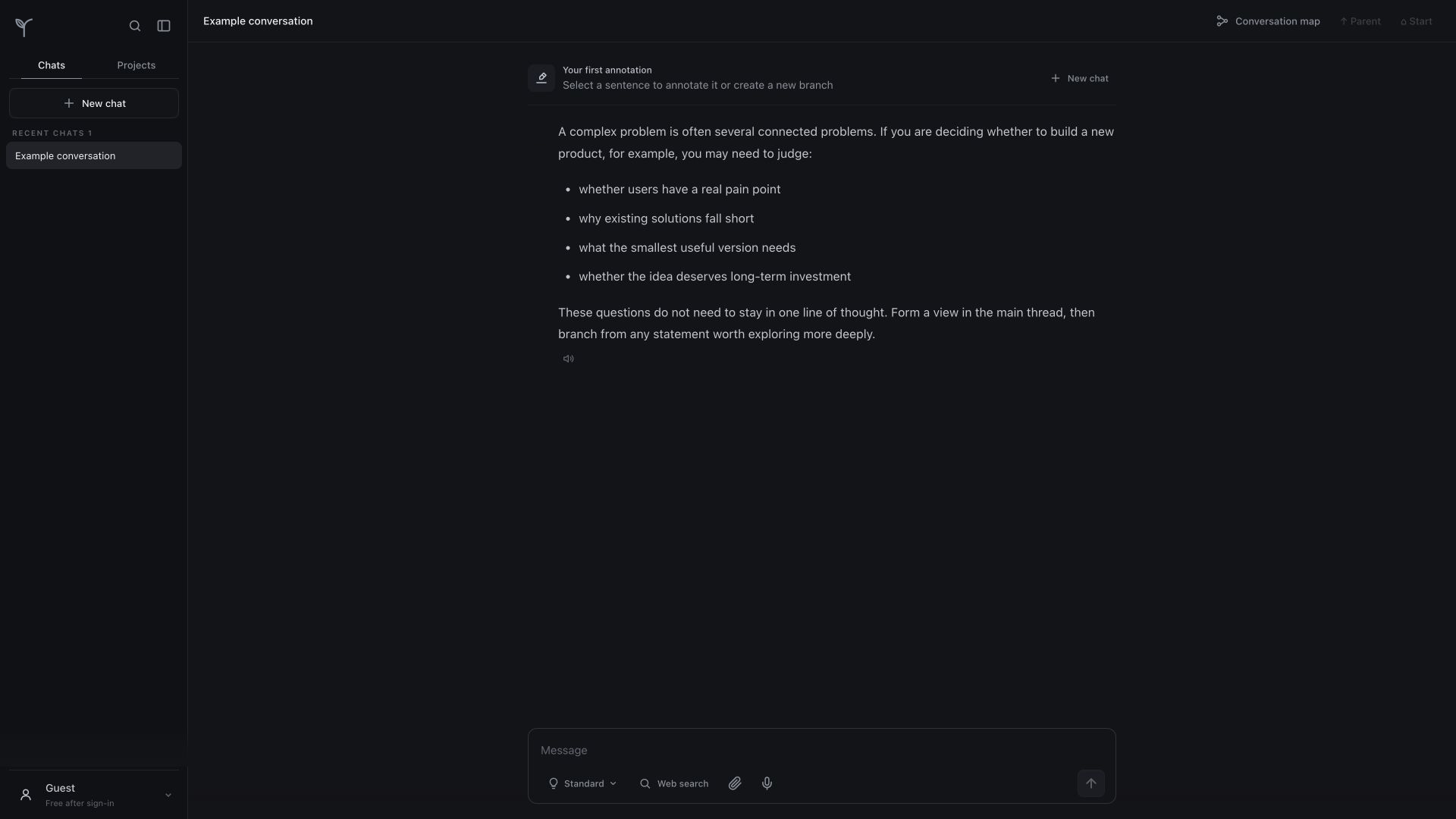
Start with one learning goal
The goal for this example is to explain what one gradient descent update does and why the learning rate matters. Keep the first question focused enough to evaluate your understanding.
Explain gradient descent using f(x) = (x - 3)^2. Start at x = 0 with learning rate 0.1. Show one update, define each term, and ask me a question to check my understanding.
Open a branch for the term you do not understand
Select the passage about learning rate in the answer, then create a branch. Use that branch to explore the term without adding every follow-up to the original explanation.
Why does the learning rate affect whether we reach the minimum? Compare 0.1 and 1.2 for this same function. Show the first update and explain what happens if we keep going.
Check the example yourself
For f(x) = (x - 3)^2, the derivative is 2(x - 3). The update is x_next = x - learning_rate × 2(x - 3). From x = 0, a learning rate of 0.1 gives x_next = 0.6; a learning rate of 1.2 gives x_next = 7.2.
In this particular example, the distance from 3 is multiplied by 0.8 with the first learning rate and by -1.4 with the second. The first approaches 3; the second oscillates with increasing distance. Work through another update to check the explanation.
Return to the main explanation
Use the return navigation or select the original node in the tree. Continue the initial learning task. A second branch can explore the derivative, while the learning-rate discussion remains on its own path.
Now ask me to calculate the next update myself. Wait for my answer, then explain any mistake before continuing.
Finish with something you can explain
- Explain the update in your own words, including the derivative and learning rate.
- Open the map and revisit only the questions you still cannot explain.
- If you want a longer study plan, organize the conversation into a project and review the proposed outline.
- Use your course material or textbook to check the definitions and worked examples that matter to your task.
Use the pattern for another topic
The same sequence works for a programming concept, a paper’s method, or an unfamiliar argument: start with a goal, anchor a follow-up to a passage, explore it, return, and test your understanding.
These prompts are examples to enter in Grenvi. Your generated answers may differ. Free use has a limited AI allowance; the product shows your remaining usage.
A reusable AI learning prompt
Replace the bracketed fields with a specific concept, what you already know, and one result you want to reach. A goal such as “calculate one update” is easier to check than “teach me machine learning.”
This template also works in a conventional chat. In Grenvi, select the unfamiliar passage to keep a follow-up in its own branch.
Help me understand [concept] so I can [observable learning goal]. I already know [prerequisites]. Use one small worked example and define unfamiliar terms as they appear. Explain the first step, then ask me to do the next step myself. Wait for my answer before continuing. Separate assumptions from conclusions. If a fact needs a source, tell me what I should verify in my course material.
A follow-up that tests one uncertainty
Before opening a branch, name the exact uncertainty in the selected passage. For the gradient descent example, ask why the update subtracts the derivative, or what changes when the step size grows. Investigate one of these at a time.
A concrete example, a counterexample, and a question you can answer yourself are more useful checkpoints than asking for another general explanation.
In the selected passage, I do not understand [specific uncertainty]. Use the same example to explain this point. Show one case where the claim holds and one relevant limit or counterexample. Ask me one question that would reveal whether I understood it. Wait for my answer.
Close the lesson with a self-check
- Return to the main thread and explain the idea in your own words without reading the answer.
- Calculate the second update for the worked example: x = 1.08 for a learning rate of 0.1, and x = -2.88 for a learning rate of 1.2. Check each substitution into the update formula.
- Try a slightly different starting value or explain what changes when an assumption changes.
- Reopen only the branch you still cannot explain. Record the unresolved question and check it against a course source.
Give me one new problem that uses the same idea with a small change. Do not provide the solution yet. After I answer, check my reasoning step by step and point out the first error, if any. Finish with a short list of what I can now explain and what I still need to verify.